


The carbon fiber customized case components of the Richard Mille RM 35-01 are by no means a simple imitation of appearance, but a complete reinvention of “hardcore aesthetics”. The so-called hard core first stems from the continuous breakthrough of material boundaries - carbon fiber itself is already a symbol of lightness and strength in modern industry, but RM 35-01 goes a step further and uses layered and staggered stacked Carbon TPT® materials, so that every edge, corner and curve carries the collision of engineering and art. The surface of the case is not smooth and flawless, but retains the subtle texture naturally formed when carbon fibers are layered, as if to tell the story of the fibers being die-cast under high temperature and pressure. Viewed from the side, the curvature of the shell has been precisely calculated, which not only meets the ergonomic wearing requirements, but also visually creates a tight and ready offensive posture. Hard core does not mean roughness, but the raw power of materials has been carefully crafted and sublimated into an aesthetic language that is cold, rational but full of speed. Every chamfer and every edge is a gentle rebellion against traditional watchmaking craftsmanship, and finally condenses on the wrist into a miniature sculpture that combines futuristic sense with mechanical belief.
The reason why RM 35-01 is called the “supercar on the wrist” lies in its perfect unity of the contradiction between extreme lightweight and high strength. The customized carbon fiber watch case components do not simply copy the appearance, but faithfully restore the soul of the original work from the physical level - carbon fiber threads are interlaced layer by layer at 45-degree angles and pressed under high temperature and pressure to form a shell with extremely low density but amazing tensile strength. The wearer can hardly feel its weight, but can feel the solid armor-like protection through touch and vision every time he raises his hand. This kind of lightness is not nothingness, but the freedom given by technology; this kind of strength is not bulky, but the toughness intertwined at the molecular level. The edges of the case are impressively thin, but even on the most stressed side, the carbon fiber layers fit snugly without a hint of looseness or weakness. Real high-end materials never rely on thickness to prove themselves, but allow lightness and strength to achieve an elegant coexistence in contradiction. The carbon fiber shell of RM 35-01 is the ultimate embodiment of this physical beauty - it silently tells every wearer: it is the ultimate and never needs redundant explanations.
The soul of Carbon TPT does not lie in how hard or light it is, but is hidden in the most inconspicuous curved part of the watch case that tests the most craftsmanship. These curvatures are like the turning and breathing points of a sculpture. They are the eternal marks left by the fierce collision of materials, pressure and temperature in the mold. When light sweeps across the curved surface of the case from different angles, the fine texture formed by the stacked carbon fibers will flicker between light and shadow, as rich and deep as geological layers. Each layer of carbon fiber threads is staggered at a constant angle, and is precisely compressed and stretched on the curved surface, which not only maintains the overall continuity of the material, but also visually presents a flowing ripple effect. Gently stroking the curved surface of the casing with your hand, your fingertips can feel the unique warmth and fine texture undulations of the carbon fiber material. It is a real touch that cannot be faked by painting or polishing. The soul of Carbon TPT is through this three-dimensional texture that is visible to the naked eye and touchable with fingertips, which elevates industrial manufacturing to the level of artistic expression. The curvature of the watch case is no longer a simple structural requirement, but has become the brand's most profound design language - a double feast of visuals and textures, and every gaze is worthy of repeated aftertaste.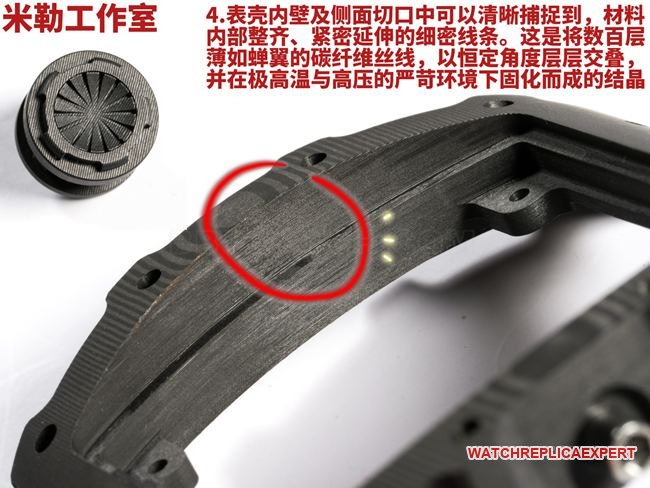
If you turn the RM 35-01 watch case over and peer deep into its inner wall and side cutouts, you can glimpse the most secret pride of carbon fiber—the neat, tight, and hair-thin lines that extend. These lines are not carved or etched, but are an internal structure that naturally appears after hundreds of thin layers of carbon fiber threads are overlaid at a constant angle and cured in a harsh environment of extremely high temperature and pressure. Each layer of fiber is precisely positioned, with almost no gaps between layers, but their respective directions can be clearly distinguished from the cuts. This orderly and almost paranoid arrangement is not for aesthetics, but to ensure that the material has uniform tensile and compressive resistance in any force direction. At the side incision, the line cuts vertically from the edge of the case, then smoothly turns, extending along the arc of the inner wall to the bottom of the case, like a geological history book, recording the changes in temperature and pressure every millisecond during press molding. What is truly moving is not the lines themselves, but the manufacturing philosophy behind them - turning the invisible internal structure into a work of art that is more exquisite than the appearance. This kind of rigor and restraint is the deepest interpretation of the word "advanced" by carbon fiber technology.
Carbon fiber itself is just a raw material, just like the paint in the hands of a painter. What really determines the height of a work is never the paint itself, but the skills and ideas that control it. The reason why RM 35-01 is fascinating is not because of how much expensive carbon fiber it piles on the case, but because it shows how humans can use technology to completely tame this unruly material. From the initial tension control of the carbon fiber threads, to the uniformity of the impregnated resin, to the angle calculation and stacking sequence during lamination, and finally to the precise programming of the temperature curve in the high-temperature autoclave - if there is a slight deviation in each link, bubbles, delamination or stress concentration will appear in the cured shell. And when we finally see the straight or curved, deep or shallow textures on the surface of the watch case, they are not random products of nature, but the visual imprints left by countless engineering decisions. Every texture is a signature written by technology on craftsmanship, which is both a guarantee of performance and a declaration of aesthetics. For those who own such a watch case, what is really worn on their wrist is not carbon fiber, but the crystallization of human wisdom accumulated over decades in the fields of material science, fluid mechanics, thermodynamics and precision manufacturing. This sense of luxury is calm, restrained, but irrefutable.
The watch case has conquered carbon fiber, and the top-level coating process has to conquer something more elusive than carbon fiber—light. The watch mirror of RM 35-01 is not an ordinary piece of sapphire glass, but an optical-grade component that has been treated with multi-layer nano-level anti-reflective coating. The thickness of each layer of coating is precisely controlled to about a quarter of the wavelength of light. Through the interference effect, the reflected light waves cancel each other out, thereby reducing glare to a level that is almost imperceptible to the human eye. This requires using electron beam evaporation or magnetron sputtering technology to deposit metal oxides layer by layer on the mirror surface in a high vacuum environment. The refractive index, uniformity and adhesion of each layer must reach nanometer tolerances. Facing direct sunlight or strong spotlights, ordinary watch mirrors will form dazzling reflections or even ghost images, but the RM 35-01 mirror that has been treated with multi-layer coating is almost invisible, allowing the hour markers, hands and carbon fiber texture on the dial to directly come into view without any interference. This precise control of light is not only a victory of optical physics, but also a humility of the senses - the mirror should not show off its existence, but should retreat behind the scenes and let every detail of the dial breathe freely. Conquering materials requires strength, and conquering light requires wisdom and patience. This is the uncompromising pursuit of RM 35-01 in every detail.
RM35-01 replica watch high-transparency glass dial
Richard Mille carbon fiber skeleton watch authentic vs fake
RM35-01 purple film coating glass quality comparison
Richard Mille TPT carbon fiber case replica
RM35-01 matte silk texture dial authenticity check
RM35-01 hollow dial replica transparency test
Richard Mille RM35-01 carbon fiber weight authentic
fake RM35-01 purple coating how to spot
RM35-01 high-grade carbon fiber replica quality
Richard Mille skeleton dial glass coating replica
RM35-01 TPT material stacked carbon authenticity
replica RM35-01 mirror surface glass thickness
Richard Mille RM35-01 case components fake vs real
RM35-01 flowing texture dial replica accuracy
Richard Mille carbon fiber skeleton watch price fake
RM35-01 invisible coating replica detection
hardcore aesthetic Richard Mille RM35-01 replica
RM35-01 layered carbon TPT replica material
Richard Mille RM35-01 dial transparency fake
RM35-01 edge corner curve carbon fiber replica
authentic Richard Mille RM35-01 weight specs
Richard Mille RM35-01 glass coating durability replica
RM35-01 skeleton watch replica material comparison
Richard Mille carbon fiber case replica flaw
RM35-01 matte texture authentic identification
Richard Mille RM35-01, skeleton dial, carbon fiber case, high-transparency glass, purple film coating, hollow dial, replica watch, matte silk texture, TPT carbon fiber, luxury watch replica
